Every month the same people pull the same exports, paste them into the same workbook, chase the same three cells that do not tie, and send the same summary later than anyone wanted it. Then they do it again.
It is the most automatable work in a finance or operations team, and it is usually the last thing anyone gets to, because the person who understands it is the person too busy doing it.
What we actually do
- Sit with whoever runs the close and write down the real process, not the documented one. Every export, every manual fix, every “and then I just know to check this”.
- Time the current cycle, so the before is measured rather than estimated.
- Build the pipeline that does the pulls, the joins, the reconciliation and the exceptions, and puts the result somewhere a finance person will actually open.
- Hand it over properly: a runbook, the credentials in your names, the source in your repository. You own it outright. Keeping it running afterwards is a service you can buy from us, not a condition of owning it.
What is not included
- Replacing your ERP, or telling you your ERP is the problem.
- Fixing data that is wrong at source. We will show you where it is wrong. Correcting it is a decision about your process, not a line of code.
- Anything that depends on access we turn out not to be able to get. If that happens, we say so early rather than late.
The honest part
We are not going to show you a client logo or a saving somebody else got. PJA Solutions is founder-led and we do not publish other people’s numbers. What we will do is measure yours before we change anything and measure it again afterwards, so the number at the end is real and it is about you.
The calculator below works the same way. There is no benchmark in it and no figure of ours. It is arithmetic on what you type.
For context that is not ours: APQC’s benchmarking puts the median monthly close at 6.4 calendar days. A 2025 survey by Ledge (n = 100, vendor-conducted, methodology disclosed) found roughly half of finance teams take more than five business days, and that 94% still run the close on Excel. Those are the industry’s figures, not results we are claiming.
What is this actually costing you?
Put your own numbers in. Everything below is arithmetic on what you type. There are no industry averages in it, no benchmarks, and no figure of ours hidden in the maths.
Nothing you type here is sent anywhere. It stays in your browser unless you decide to put your details in the form below, in which case the figure you worked out comes with it so we start the conversation from your numbers rather than from a brochure.
See it run
PJA Solutions maintains an internal reference build of a month-end close. Reference build. Synthetic data. There is no client. It uses synthetic data for a fictional company — a 649-row ERP general-ledger export, a 900-row webstore order export, and a hand-maintained mapping-and-adjustments workbook — and it produces July revenue and gross margin by reporting segment and product line, reconciled between the two systems.
We counted what that data forces a person to do before any total from it can be trusted: 1,408 discrete manual interventions — 1,137 individual cells that will not participate in arithmetic until they are repaired, and 271 rows that must each be looked at and kept, dropped or reclassified. 29 of those are irreducible judgement calls, where no formula produces the answer and a person has to decide: which parked documents to exclude, which late-posted accruals to include, which of two plausible timezone conventions sets the reporting month, what to do with a SKU the mapping workbook has never heard of.
We then reconstructed that close by hand, step by step, with no end-to-end scripting — 31 numbered steps, every judgement call surfaced and logged — so that the automation below could be built against a documented procedure rather than a guess. The same reference build contains an automated pipeline over the identical inputs, and the two independent answers are reconciled against each other.
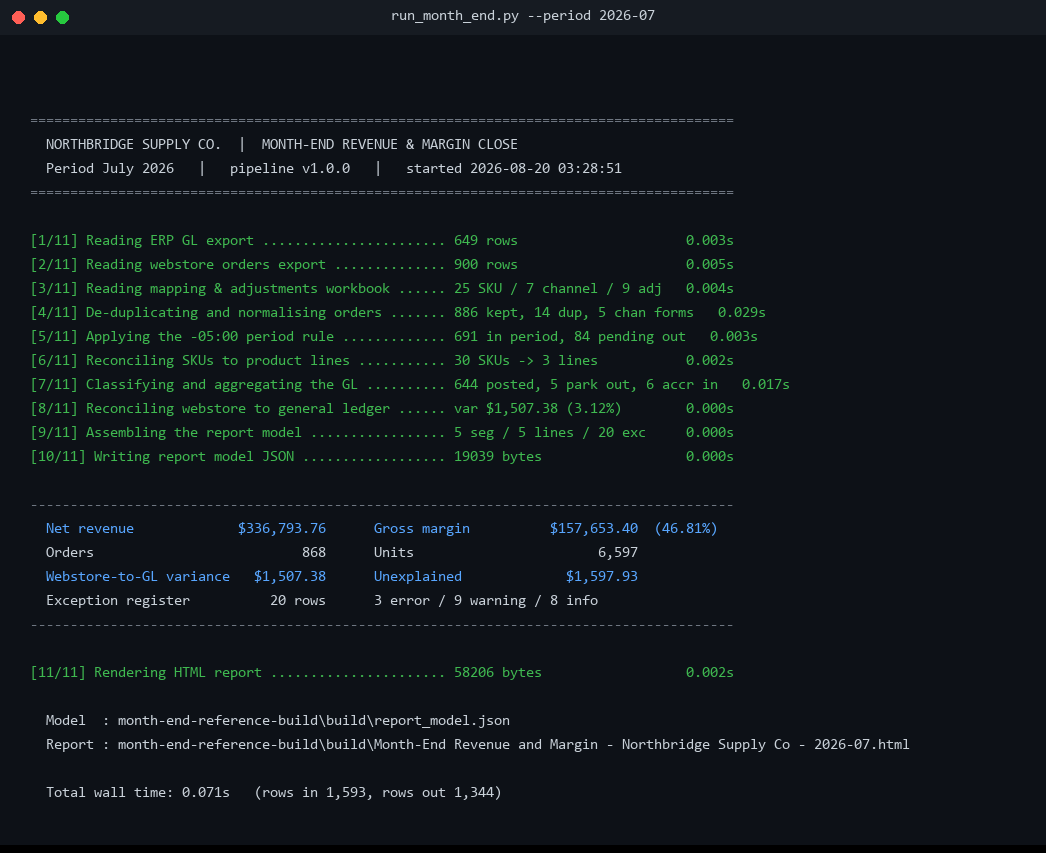
Open the finished reference-build report — the exact self-contained HTML file that run produced: the segment and product-line breakdown, a revenue bridge, and a reconciliation that discloses the residual it could not explain rather than hiding it. This is a reference build on synthetic data, not a client engagement, and we do not publish a time saving for it. How long a close like this takes depends on the person doing it, and we did not measure a person. If you want that number for your close, we measure it on your report, with your analyst, during the paid diagnostic — and you keep the measurement whether or not you go further with us.
Who this is for
Companies where one competent person loses a chunk of every month to a report that never changes. Usually manufacturing, distribution, e-commerce or professional services, somewhere between 20 and 500 people, with an ERP and a spreadsheet that has quietly become load-bearing.